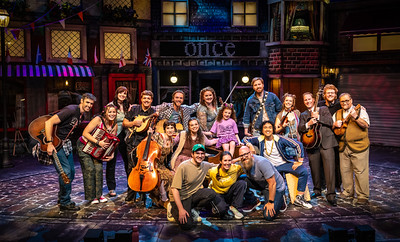
What is Once?
Once is a heartfelt musical about a street musician and an immigrant pianist who meet in Dublin and form a deep creative connection through songwriting. Rather than being a big, flashy Broadway-style spectacle, it’s intimate, minimalistic, and grounded in everyday life.
The stage musical has a cozy vibe. The music is folk-inspired, with live musicians onstage, and features the Oscar-winning song “Falling Slowly.” It’s a bittersweet story about music, hope, and finding inspiration in unexpected places.
Choreographing Once for Centerpoint’s 2026 season was also the most unique challenge I have taken on as a musical theatre choreographer.
A Musical with Unique Needs
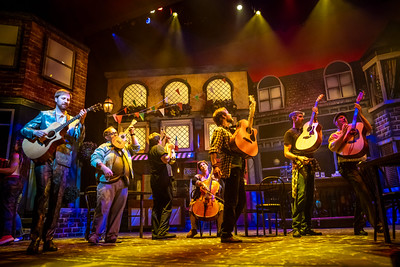
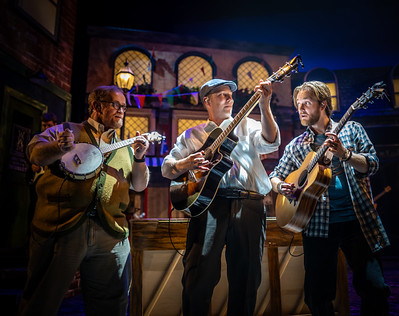
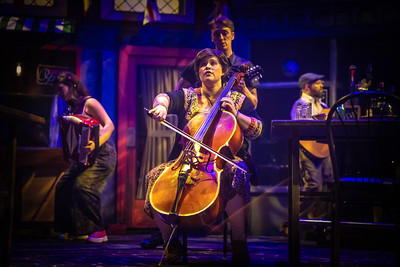
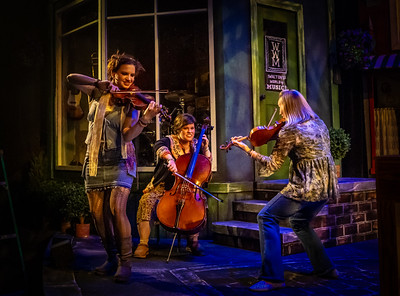
It’s not just live musicians onstage. The cast holds instruments and has to play them while they sing, sometimes during scenes and sometimes during scene changes, sometimes as characters and sometimes not. This can be crazy complicated. The vibe of the show isn’t dancey, but the body is a communicative, expressive tool in the musical theatre toolkit and you can’t just park and bark–or park, bark, and strum. I’m of the opinion that at minimum, you should give the audience a reason to keep their eyes open. Even better than that, and essential to the way that I want to make theatre, all visuals on stage should do what the script does and the actors do–communicate the plot, character, and thought of the piece to the audience with clarity, depth, and without patronizing them or adding needless distraction. But how to create meaningful, essential movement that rewards attention while some of your cast has to sit to play a cello or drums but others are on their feet playing accordions, guitars, or violins?
A Process with Unique Needs
The cast was in music rehearsals for two months before I worked with them on their movement. I sure felt like the outsider to an already bonded group. As a choreographer, I always want my cast off-book before we dance. This group had to have lyrics, notes, and fingering memorized and now I’m asking them to add another physical task that won’t always be rhythmically in sync with all the above elements because they aren’t all playing the same rhythms or singing the same lyrics. My presence and my ask both felt disruptive. Good thing our cast was game and we still had six weeks before opening.
I decided this show would be a great chance, and possibly demand, that I try a different process of choreography. I created a Frankenstein of different approaches–some devising, some Viewpoints, some Laban Efforts, some traditionally created and taught choreography. There wasn’t a callback for movement as part of the audition process, so I used my first hour with the cast to see how they moved and develop a common vocabulary.
I prepare before going to rehearsal. I also try to read the room and pivot as needed. This show really tested my trust in myself for both of those abilities.
A Space with Unique Needs
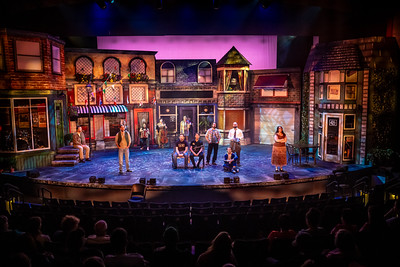
Did I mention that the set changes were done by the cast? Yeah, the cast that is also playing the music. Play your instrument but also move this table at the same time, okay? The show is constructed with multiple settings that change rapidly. Even though it doesn’t need a realistic approach to building out each location, the plot can get muddled if the audience can’t tell when and where the characters are. CPT’s set design by Truxton Moulton did a great job but we still had things to figure out about the logistical flow between scenes. It was my task to make sure the logistics were accomplished beautifully and expressively while still fitting in to the time the music allowed. The set we landed on had far fewer levels than I prefer to work with, some tricky bits with sight lines, and the additional priority of how actors wearing multiple mic packs (some for their voices, some for their instruments) change the soundscape of the space acoustically and electronically.
What I’ll Take With Me
I want to carry forward what I developed in my choreographic process and how to articulate ideas and notes about movement and bodies with clarity and insight. I feel better equipped to work with performers who don’t have a process perfectly in-line with what I expect. Once will be an important part of the narrative of the kind of choreographer I am and the kind of choreography I want to work with. I expect Once will be an essential data point in the evolution of my work, not just in terms of product, but in terms of process. I’ve had a long love for figurative language and Once has given me an appetite for figurative movement. On a larger level, Once encapsulates my growing comfort and love for stories that aren’t simple, ideas that aren’t binary, and structures that are elegant.
“Love’s all very well but in the hands of people it turns into soup.” —Bank Manager
Working on Once was good soup.